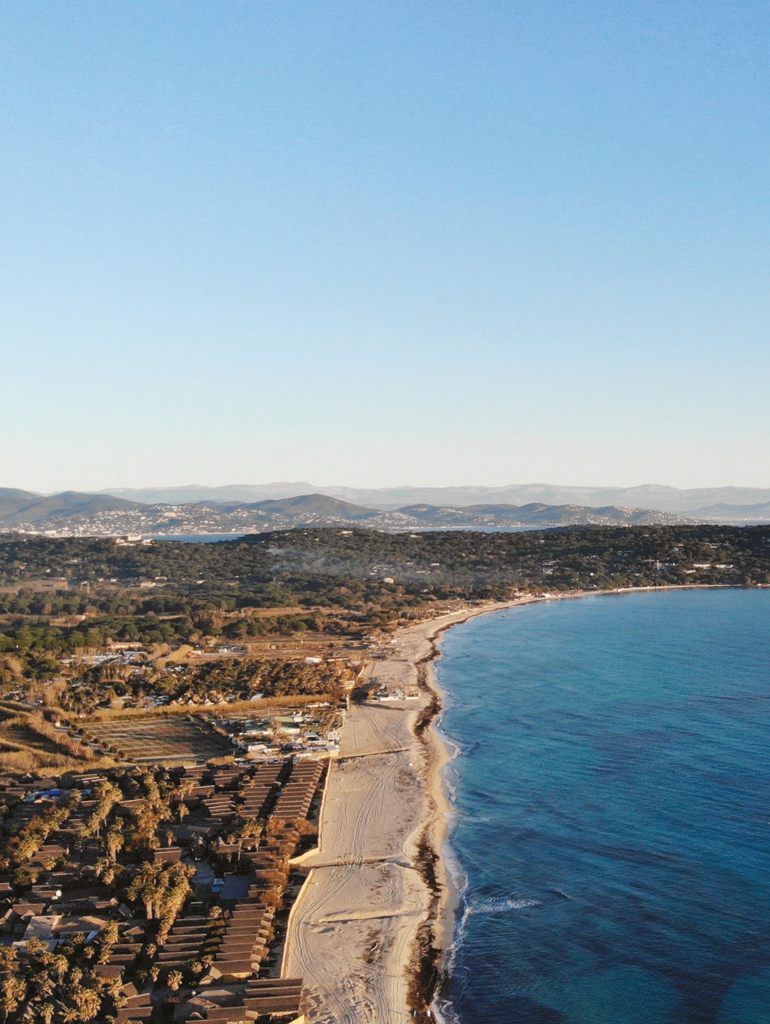



Pampelonne beach: the rebirth of a myth
A symbol of nature caught between dunes and sea, casting its spell over every visitor, it has, in spite of itself, undergone a great many changes of late. Are we on the eve of an upheaval of the coastline? Or of an unprecedented renewal? Jacques Naveau, president of the association of Pampelonne beach operators and owner of the Cabane Bambou, sets out the situation for us, no matter that his reading of it is a partisan one.
CHANGES AND OBLIGATIONS
“Among the principal changes, we go from 27 to 23 beach establishment lots, made up of 8 concessions for reversible lots and 15 concessions for lots with demountable establishments, one of which remains unawarded and another which must be put out to tender again. The particularity of the 8 reversible-lot concessions is that they sit partly on the domaine public communal (DPC, the commune’s public land) and partly on the domaine public maritime (DPM, the maritime public domain). On the DPC it is permitted to build a reversible establishment which is under no obligation to be dismantled for the duration of the concession, which runs for 12 years. The defining feature of a reversible establishment, however, is that were it to be dismantled one day, the land on which it was built would have to be returned to its original state. That is also why nothing is built in concrete. On that same lot, a small demountable structure of no more than 30 m² may be installed on the DPM from the month of March, with an obligation to dismantle it in October. It should be noted that reversible establishments are required to remain open for a minimum of 10 months, which may appeal to clients who like to come out of season.
The other type, the so-called demountable beaches, are the beach establishments that sit entirely on the DPM. They are subject to other constraints, and not minor ones. For the duration of their 12-year concession, each year the operators are permitted to install their demountable establishments from the month of March, and these must be completely dismantled by 31 October at the latest so that the space is left clear. This coming and going of demountable establishments remains one of the paradoxes of the schéma d’aménagement (the development plan imposed by central government): namely the carbon impact it will ultimately have on our environment, with the two heavy-plant operations that each year will move in and move out the dozens of modules making up a demountable beach lot, and that without counting the difficulty of finding storage, which may lie tens of kilometres from the beach. I think we still have work to do on these constraints and must find the best solutions to lessen their impact.”
WHERE THINGS STAND
“Today, after all this upheaval, Pampelonne is recovering part of its natural state. The beach is settling back into itself. Change was needed; that much was obvious. The only controversy around the government’s determination to enforce strict coastal legislation was justified by the fact that we did not want to lose the number of existing establishments. That could have a social and economic impact on the gulf, if only through the loss of jobs. We were not against the schéma; we wanted it to evolve differently, because the government has a duty to respect the diversity and the particularities of each region, which are what make our France so attractive. Now we must put an end to the squabbles in the corridors. It is the past that has made us what we are today. It is today that we must build tomorrow, while protecting our environment. And it is by respecting this schéma d’aménagement that we can already appreciate the new visual character of the setting, which will once again make Pampelonne the model beach at international level.
There has been colossal investment on the part of all the businesses that were successful when the concessions were reallocated in 2018. Pampelonne will be different from before, but in a good way. It simply needs a little time for everything to mature, for everything to settle into its natural order. On the whole, I sincerely believe it will be a success.”
ECONOMY, TOURISM AND WHAT IS AT STAKE
“Following these large investments, each of us will apply his own commercial policy, according to his own criteria, in order to make the best return on his interests. We are not philanthropists; we are here to offer a quality service in a remarkable setting. In fact this schéma has obliged us to surpass ourselves in infrastructure and architecture as much as in technical and aesthetic terms. Of course there are still plenty of ‘little things’ to harmonise over time. Pampelonne was not built in a day, but after only four months we can already see a fine result taking shape.
The problem we have had for years is the lack of housing needed to accommodate qualified staff. It would be sensible, in everyone’s interest and with the support of the communauté de communes (the grouping of local communes), that we should manage to find a solution to this recurring difficulty. With the beach establishments open 10 months of the year, it would be desirable for all the businesses concerned to play their part in welcoming clients, so that a new economic dynamic may emerge in our region. Our département enjoys a tourism potential that it would be a shame not to make use of all year round.”
In the end, if politicians are often accused of inaction and the French of being closed to change, the metamorphosis of Pampelonne beach is an almost perfect illustration of an effort led collectively in the general interest. A world example of a transformation that is both economically sustainable and respectful of the environment, Pampelonne today regains its standing. It enters the twenty-first century with an ambition equal to the demands of our age. It now remains only for the other businesses to follow suit, and for visitors to judge for themselves this genuine rebirth of the Pampelonne myth.